
What Are Hedge Funds — And Why Should Forex Traders Care?
Walk into any serious trading firm and you'll hear the same phrase echoed by the most consistent profit-makers: "Trade like the institutions." But what does that actually mean in practice? Hedge funds are privately managed investment pools that operate under far fewer regulatory constraints than traditional vehicles like mutual funds. That freedom is not just a legal technicality — it's their greatest competitive weapon.

Unlike your typical retail forex setup — where you're watching a 15-minute candle and hoping for a pip gain — hedge fund managers are running multi-layered conviction trades built from months of research. They blend macro-level insights, quantitative signals, and deep qualitative reading of market participants. And the good news for active forex traders? These frameworks aren't some mysterious black box. They're learnable.
Hedge funds use a wide variety of strategies, ranging from long/short equity plays to global macro bets that capitalize on broad geopolitical and economic shifts. For the forex trader, the macro-focused strategies are particularly relevant because currency markets are among the clearest mirrors of macro conditions. Interest rates, inflation differentials, central bank policy — these are the bread and butter of both macro hedge funds and intelligent forex speculation.
The 5 Factors Every Serious Analyst Examines
Whether you're evaluating an external hedge fund as an investment or applying their analytical lens to your own trading decisions, these five pillars form the foundation of professional assessment. Skip one and your analysis has a blind spot.

Quantitative vs Qualitative: The Analysis That Actually Works

The Numbers Side: Quantitative Analysis
Quantitative analysis is the backbone of modern hedge fund evaluation. It involves using mathematical and statistical models to assess a fund's performance in a way that removes emotional bias. For forex traders, this translates directly: apply the same rigor to your own trading journal.
- ✓Sharpe Ratio — measures return per unit of risk. Anything above 1.5 is considered excellent for a hedge fund strategy.
- ✓Maximum Drawdown — the deepest valley from peak to trough. A key measure of how bad things can get before they recover.
- ✓Correlation Analysis — how does the fund's performance relate to broader market moves? Low correlation = genuine alpha.
- ✓Win Rate & Profit Factor — a 40% win rate with a 3:1 reward-to-risk ratio still beats a 70% win rate with 1:1.
The Human Side: Qualitative Analysis
Here's where most retail forex traders completely drop the ball. They obsess over charts but never ask the deeper question: who is on the other side of this trade, and what are they thinking? Qualitative analysis in hedge fund terms means understanding investment processes, team dynamics, risk management culture, and whether the manager's stated philosophy actually matches what they do in practice.
Applied to forex trading, this is the discipline of reading central bank language, tracking institutional sentiment reports like the COT (Commitment of Traders) data, and understanding when a currency move is driven by fundamentals versus panic positioning. It's the difference between trading noise and trading conviction.
- 1Start keeping a trading journal that tracks not just P&L but the reasoning behind every trade. Hedge funds live and die by post-trade analysis.
- 2Calculate your own Sharpe Ratio monthly. If it's below 1.0, your risk management needs attention before your strategy does.
- 3Read COT reports every week. They tell you where institutional money is positioned — and that is always more meaningful than retail sentiment surveys.
- 4Run scenario stress tests on your open positions. Ask: what happens to this trade if the Fed surprises with a 50bps hike?
- 5Benchmark your performance against peers. Are you outperforming the relevant forex indices, or just riding macro tailwinds?
- 6Always account for liquidity in your position sizing. The spreads during London close are not the spreads during a flash crash.
Stress Testing: The Technique That Separates Good Traders From Great Ones
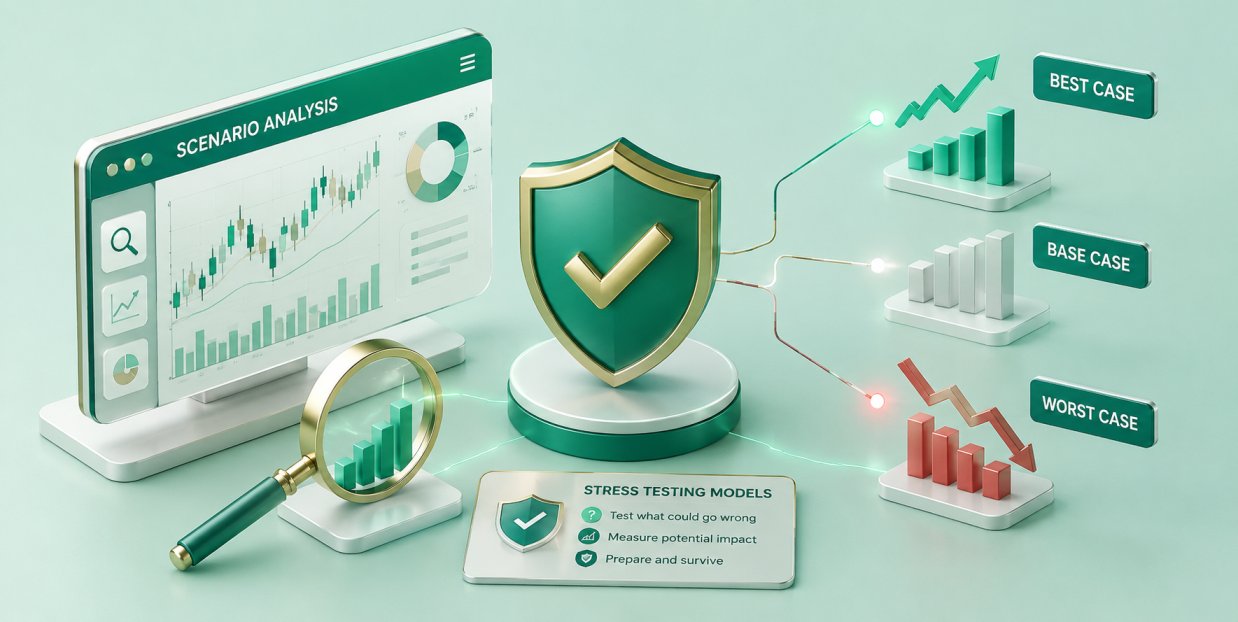
One of the most underused tools in retail forex is scenario analysis — and yet it's standard practice in every institutional trading desk worth its salt. The idea is simple: instead of just asking "what will happen if my view is right?" also ask "what will happen if I am completely wrong, and how do I survive that?"
How to Run a Basic Stress Test on a Forex Trade
Let's say you're long EUR/USD ahead of an ECB meeting. Before placing the trade, a hedge fund style stress test would look something like this: Scenario A — ECB delivers as expected, EUR rallies 80 pips. Scenario B — ECB surprises dovishly, EUR drops 150 pips. Scenario C — a black swan event (geopolitical shock, surprise Fed statement) sends volatility spiking and spreads widen to 30 pips, triggering your stop at a worse level than expected.
By pre-mapping these outcomes, you can size your position such that even Scenario C does not blow your monthly drawdown limit. This is not pessimism — it's professionalism. The best hedge funds don't survive because they're always right. They survive because they never let being wrong become catastrophic.
Peer Group Comparison: Know Your Competition
In the hedge fund world, a fund is never judged in isolation. Its returns are benchmarked against peer funds running similar strategies. This peer comparison model is incredibly powerful for forex traders too. Are your returns this quarter driven by skill — or are all G10 breakout traders up 12% because the USD just happened to trend for six weeks straight?
The honest answer to that question is the foundation of real trading improvement. At fxTsignals.com, our signal analysis framework is built on exactly this kind of peer-relative thinking, helping traders understand not just what to trade but why the edge exists in the first place.
Conclusion: Think Like a Hedge Fund, Trade Like a Professional
The gap between retail forex traders and institutional managers isn't the size of their accounts. It's the depth of their analysis and the discipline of their process. Hedge funds succeed not because they have some secret access to information the rest of us don't — they succeed because they've systematized the right questions and they answer them honestly, even when the answer is uncomfortable.
Performance history, risk-adjusted returns, manager conviction, liquidity awareness, and fee consciousness — these five pillars of hedge fund analysis translate directly into better forex trading. Add quantitative rigor, genuine qualitative reading of market participants, and regular stress testing, and you have a framework that stands up to professional scrutiny.
The market rewards traders who do the work that others skip. At fxTsignals.com, we help you skip the noise and get straight to the signals that matter — built on exactly the kind of institutional-grade analysis we've explored in this article.